
People Problems are Team Design Problems
The problem is the default system people are dropped into.

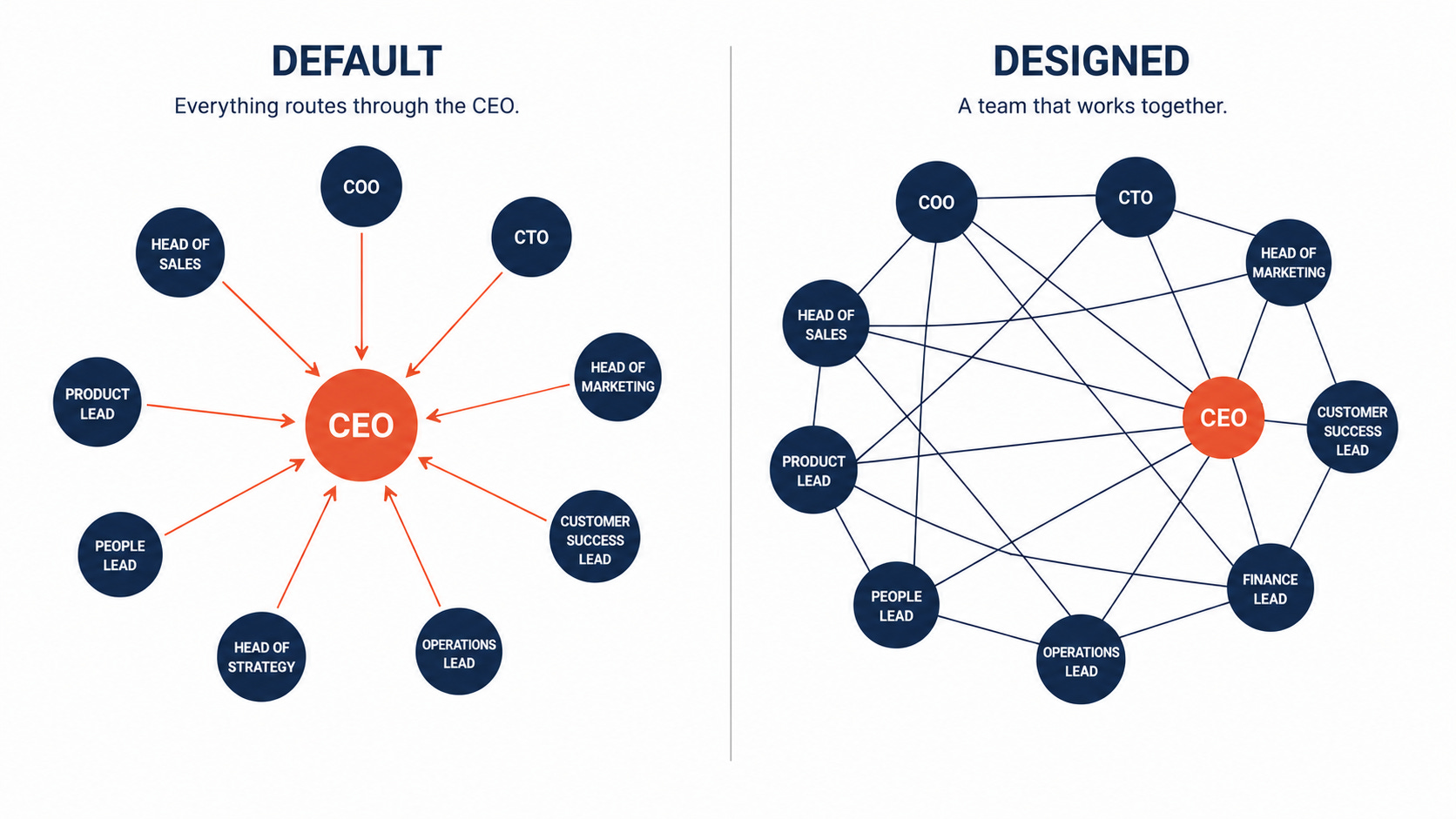
(Client stories are composites. Details are changed to protect confidentiality)
Let me tell you about a time I misdiagnosed a client.
This client - call her Maya - was the CEO of a Series C startup who wanted help with her team. The company needed to hit targets, but they were so off that the board kept calling her weekly. The company was on its third Head of Marketing. Maya was working flat out to try to make up for what she thought was a slow team. Sleep deprived. Burned out from having to jump in via 11pm Slack messages to engineers, going around their leaders to do so.
The first thing Maya wanted help on was the conflict with her Head of Marketing. Maya wanted the Head of Marketing to push harder to support Sales, and she thought that he wasn’t getting the memo. Things were slow, projects took forever, and he never had the details of campaigns at his fingertips.
So we had a classic conflict resolution session. Maya wanted faster movement on campaigns; the Head of Marketing wanted Maya to stop her outbursts at his staff during meetings. At the end of the meeting, they smiled and shook hands, and all seemed well.
Until it wasn’t. Three months later, the Head of Marketing was out.
The conflict resolution hadn’t fixed things.
The clues as to why had been there from our first coaching session. Maya had told me that this Head of Marketing was incompetent, slow on the uptake, slow to respond, always defensive. He refused to do some of the things Maya asked him to do. So I expected to meet a mulish executive during the pre-conflict resolution 1:1 with the Head of Marketing.
Instead, I met a perfectly reasonable person who cared about the work. He had bags under his eyes. He sighed and said, “I really care about my team and want to do a good job. Only problem is, they’re stressed out, and Maya keeps yelling at them in meetings. I’m taking the heat so that my team doesn’t get whiplashed. I’m the one giving feedback to Maya so they don’t have to. I guess I’m paying the price for it.”
The man I’d been hired to mediate against wasn’t the problem; he saw it more clearly than anyone.
My mistake as a coach was twofold:
First, I took the CEO’s word for it. I never saw how the team operated in reality. But working problems through one person’s lens is like taking a disgruntled family member’s word for how things actually are in a family.
Next, I worked the symptom (the conflict) instead of the root causes. Maya hadn’t designed the conditions her team needed to operate. Four defaults were driving the conflict, and I missed all of them:
No mechanism for hard truths: The team couldn’t push back on a target they all knew was impossible, and this created pressure that set off the conflict.
False clarity: Maya felt clear each time she “updated the vision and purpose”, but everyone else got less clear.
Vibe hiring: Maya hired for “potential” and brand and chemistry, instead of folks who had done the job before at this stage; this resulted in the revolving door that was the Head of Marketing role.
Culture by leader: The company did not have concrete norms of behavior around disagreement, escalation, decision-making and delegation. Maya’s behavior became the default.
I’ve thought about Maya often in the years since and about how common her challenges were.
This type of symptom vs root cause pattern comes up again and again:
The conflict between Product and Marketing that persists no matter who sits in those roles.
The CEO who can’t keep Heads of (insert function) in the role.
The executive team that is worn out and demoralized even though the company is beating targets.
The leader who just spent 6 months working on vision and mission only to hear from the team that everyone is confused about direction.
An executive team that has grown to 19 members with the CEO wondering why everyone’s avoiding ownership and nothing gets done.
The problems look interpersonal; the root causes are often structural. But we keep working the symptoms.
When something on your team looks like a people problem, ask design questions: Do we have clear alignment on goals? Clean decision rights? Is the executive team the right one for this stage? Can people disagree productively? What behavior am I modeling?
And when you look for help, be skeptical of any coach - including me - who diagnoses your team by talking only to you.
See this for how to design team interactions.
Build Team Capacity by Cutting 1:1s (5 mins)

TLDR: Too many 1:1 meetings can create bottlenecks and dependency, making leaders indispensable instead of empowering their teams. Reduce your 1:1s to fewer, higher-quality career conversations, and shift your time to team-driven meetings like Momentum Meetings, Tiger Teams, Cross-Functional Capability meetings, and Joint Assignments.
Curious: What people problems do you have on your team that don’t seem to go away?